The Bakery and the Brewery
In 1993, a young man named Antoine Bosteels was staring at a loaf of bread.
Not any bread. A multigrain loaf from a bakery near his family's brewery in Buggenhout, a small town in East Flanders. The bread was made with wheat, oat, and barley. It had a complexity that single-grain loaves didn't. Antoine looked at it and thought: why can't beer do this?
His family had been brewing since 1791: seven generations of Bosteels, starting with Jean-Baptiste, who founded the brewery 39 years before the Kingdom of Belgium even existed. They'd survived the pilsner wave of the 1960s and 70s that killed off countless Belgian specialty brewers. Antoine's father Ivo had kept the lights on with pale ales and pilsners before finally taking a risk on a specialty beer in the mid-1980s: Kwak, served in its iconic wooden-cradled glass.
Now it was Antoine's turn. He wanted to create a tripel. But not a conventional one. He wanted three grains (wheat, oat, and barley) working together the way they did in that bread. Each contributing something the others couldn't.
He spent three years perfecting the recipe. The beer was exceptional. But it didn't have a name.
The Ghost Recipe
Then Antoine found the manuscript.
Browsing a book about regional breweries, he came across a reference to a beer recipe from 1679, originating from the Carmelite monastery in Dendermonde, a fortified town about 20 kilometers from his brewery on the Schelde river. The Carmelites had been there since 1655, brewing beer as monasteries across Belgium did.
The original recipe survived in a parchment-bound manuscript held in the Carmelite archive in Ghent. Tucked at the end of a list of deceased monks and monastery debts was an "Instruction to brew 16 barrels of good beer." It called for twelve vats of wheat, thirty-six of barley, and six of oat, along with forty pounds of hops, coal for roasting the malt, and wood for heating the wort.
Three grains. The same three grains Antoine had been brewing with for three years.
"I looked and it contained the same grains that we had used in our test beer and for 90% it was the same formula."Antoine Bosteels
The monastery itself was long gone. The French expelled the Carmelites in 1796. The building became a courthouse, which the Germans burned to the ground during World War I. No trace of the monks remains in Dendermonde today.
But the recipe survived, hidden in the back pages of a death register, waiting three centuries for someone to recognize it. Antoine named his beer Tripel Karmeliet in honor of the monks whose recipe so closely mirrored his own.
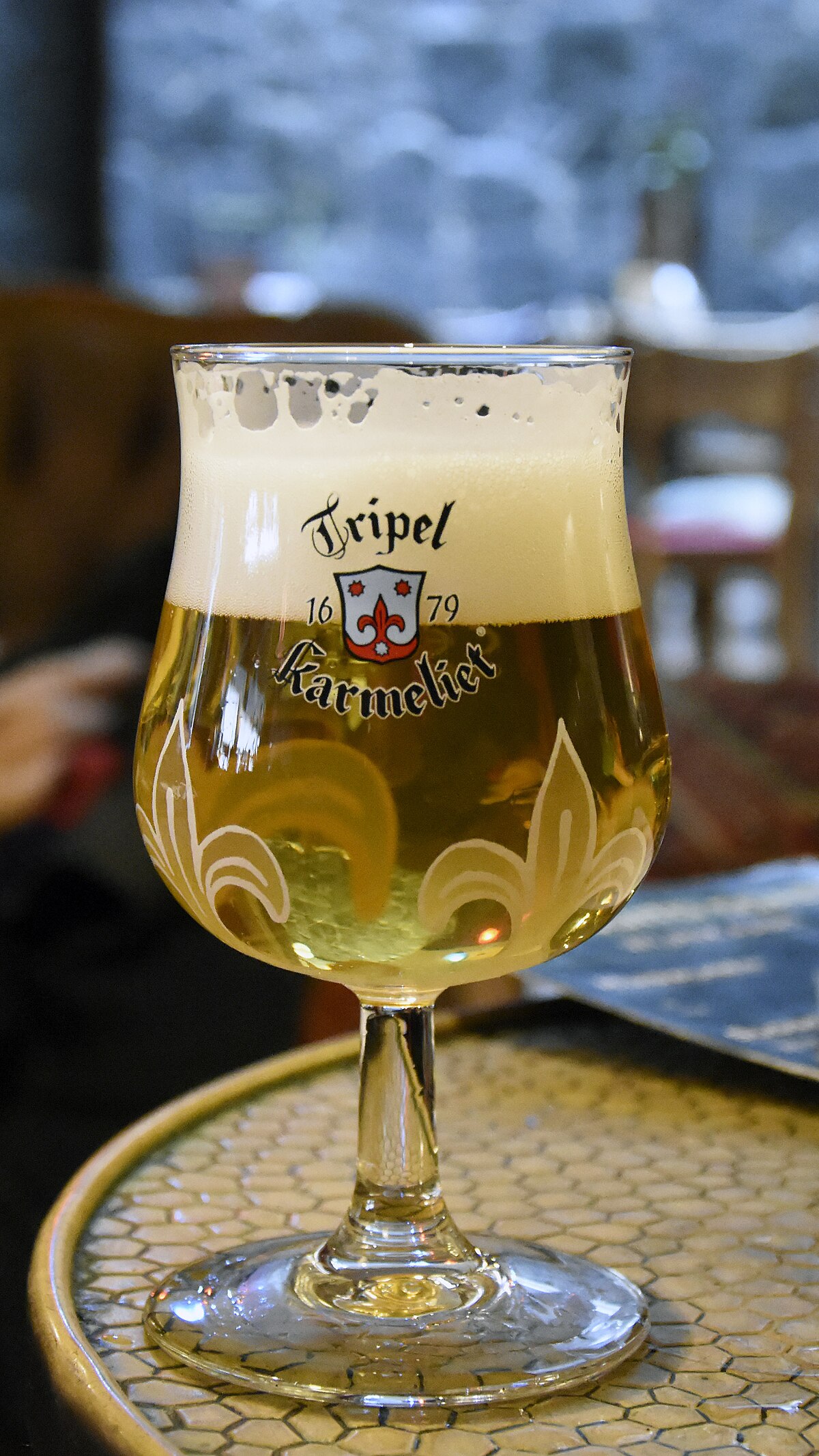
Photo: Paul Hermans / Wikimedia Commons (CC BY-SA 4.0)
What's in the Glass
Tripel Karmeliet is 8.4% ABV, golden-blonde, and unlike any other tripel you've had.
Most tripels rely on a single grain, barley, to build their structure. Karmeliet uses three, and each one does specific work. The barley provides the backbone: the malt sweetness, the alcohol, the body. The wheat adds a soft, rounded quality: a breadiness that smooths the edges and builds the dense, pillowy head of foam. And the oat is the secret ingredient: it gives Karmeliet its signature silky, almost creamy mouthfeel. It's why the beer feels luxurious on the tongue in a way that single-grain tripels don't.
The aroma opens with banana and vanilla, classic Belgian yeast esters, layered with citrus zest and a whisper of clove. The taste delivers on everything the nose promises: honey sweetness tempered by that wheat softness, soft stone fruit, a restrained bitterness that never overwhelms. The finish is long, dry, and gently warming.
It is, in a word, refined. This is not a beer that shouts. It's a beer that unfolds.
Flavor Profile
Aroma
Banana, vanilla, citrus zest, light clove spice
Taste
Creamy wheat, honey sweetness, soft fruit, restrained bitterness
Mouthfeel
Silky, full-bodied, effervescent, oat-driven creaminess
Finish
Long, dry, slightly spicy with lingering warmth
8.4%
ABV
3
Grains
1996
First Brewed
The Glass Matters
Tripel Karmeliet is served in a distinctive chalice, wide-mouthed with a slightly flared rim and a thick, short stem. It's not decorative. The wide mouth lets the complex aroma reach your nose with every sip. The shape holds the thick crown of foam that's essential to the experience. Karmeliet's foam is denser and more persistent than most tripels, thanks to the wheat and oat proteins.
At Mort Subite, we serve it in the proper Karmeliet glass. We pour it the Belgian way: slow, deliberate, tilted at 45 degrees, straightened as it fills, finished with a thick cap of ivory foam. The whole ritual takes about 90 seconds. It's worth every one of them.
Hold the glass up to the light and you'll see the golden haze. That slight cloudiness is the wheat and oat doing their work. A filtered beer would be clearer. But it wouldn't be Karmeliet.
The Awards and the Shortage
Tripel Karmeliet launched in 1996. By 1998, it had won the Gold Medal at the World Beer Cup. In 2008, it took "World's Best Pale Ale" at the World Beer Awards. That win triggered something the Bosteels family hadn't anticipated: a worldwide Karmeliet shortage. Demand spiked so fast the brewery couldn't keep up.
The beer has since accumulated more than 40 international awards. It consistently ranks among the top-rated Belgian beers on every major platform. And in 2016, Duvel Moortgat, the same family behind Duvel, acquired Brouwerij Bosteels, bringing Karmeliet under the same roof as another beer we pour at Mort Subite every day.
Antoine Bosteels' gamble, a multigrain beer inspired by a loaf of bread and named after a ghost recipe from a destroyed monastery, had become one of Belgium's most celebrated modern classics.
How to Drink It
Tripel Karmeliet is best between 44-50°F (6-10°C). Not fridge-cold. You want the aromatics active. Pour it slowly into the proper glass. Let the foam settle. Take a moment before your first sip.
Pairs Well With
Or drink it on its own. Tripel Karmeliet doesn't need food to justify itself. It's complete.
A Recipe That Waited
There's something satisfying about the story of Tripel Karmeliet. A young brewer has an idea. He spends three years making it real. Then he discovers that monks had the same idea three hundred years earlier, written in the back of a death register, in a monastery that no longer exists, in a city that was burned to the ground.
The recipe waited. Through revolution, war, and fire. Through three centuries of Belgian brewing history. Until someone with the same instinct, the same conviction that three grains are better than one, found it and gave it a name.
Check the draft menu, or ask the bar what is on today. Come taste it in its proper glass.